

By Media Mentor | Future-Ready Skills & Career Guidance
Imagine applying for your first internship or campus placement and being asked:
“What skills do you have apart from your college degree?”
What would your answer be?
In today’s competitive job market, having a degree is important, but demonstrating additional skills can help your profile stand out. And one of the most valuable skills students can start developing in 2026 is Artificial Intelligence (AI).
Whether you are studying Commerce, Arts, Science, Management, Mass Communication, Engineering or any other discipline, AI is becoming relevant across industries.
From creating presentations and analysing data to conducting research, developing marketing strategies and automating repetitive tasks, AI tools are changing the way people study and work.
But here’s something many students don’t know:
You don’t have to spend thousands of rupees to start learning Artificial Intelligence.
Some globally recognised technology companies and the Government of India offer free AI learning programmes through which students can earn certificates or digital credentials.
At Media Mentor, we believe that students should start building their professional profiles before graduation.
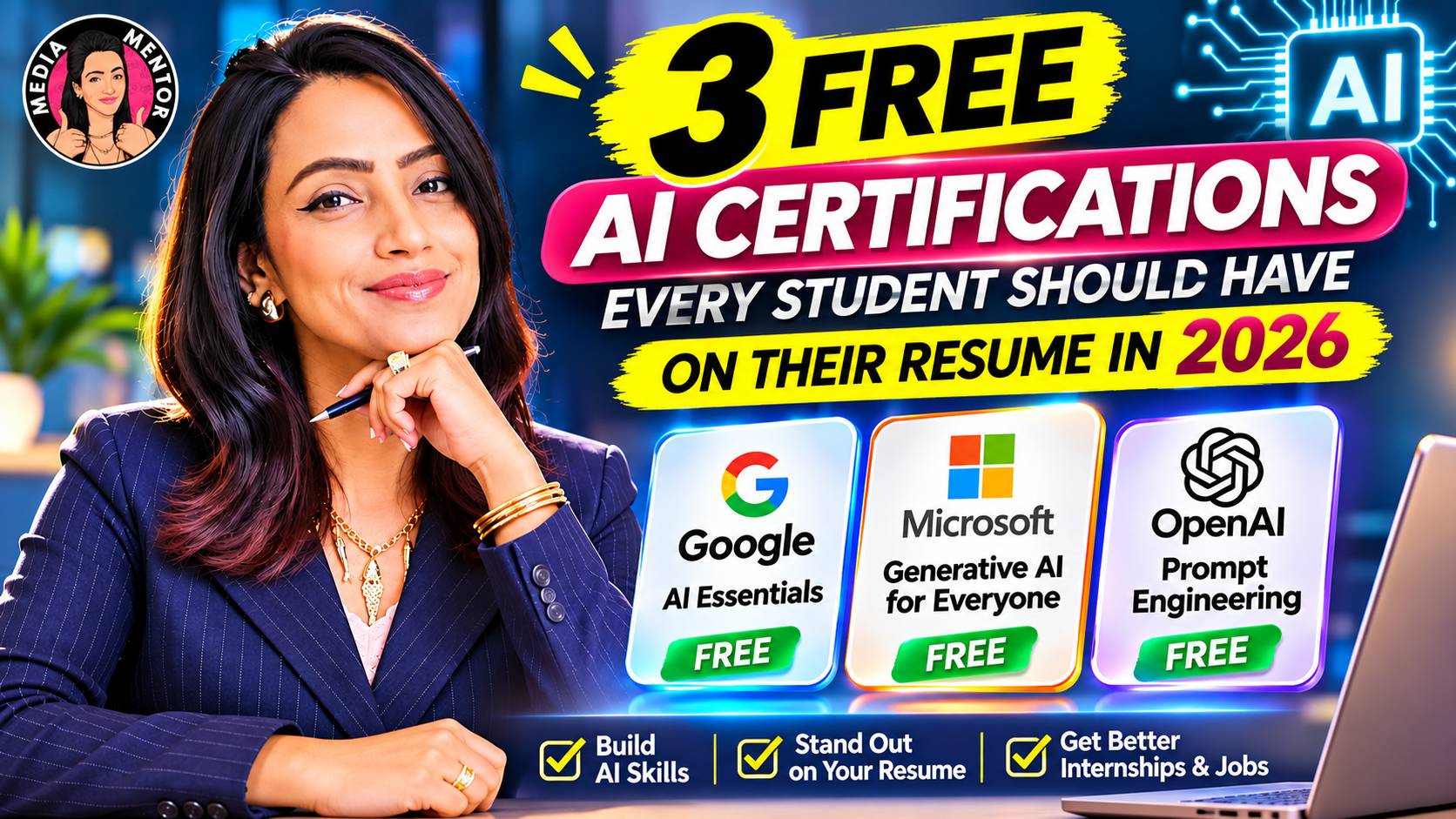
So, here are 3 free AI certifications every student should consider adding to their resume in 2026, including what you will learn, how to enrol and how each credential can support your career journey.
Why Should Every Student Learn AI in 2026?
AI is no longer limited to computer science students or software engineers.
Today, AI applications are being used across:
- Marketing and advertising.
- Banking and financial services.
- Media and journalism.
- Education and research.
- Human Resource Management.
- Business and entrepreneurship.
- Healthcare and data analytics.
- Design and content creation.
For example:
A BBA student can use AI to understand market trends and prepare business presentations.
A Mass Communication student can explore AI-assisted research, content ideation and media analysis.
A B.Com student can learn how AI supports financial analysis and business reporting.
An Arts student can use AI tools for research, writing, productivity and creative projects.
This is why learning AI is becoming an important part of career readiness.
However, simply knowing how to use ChatGPT is not enough. Students should understand how AI works, how to use it responsibly and how to apply it to real-world problems.
Let’s explore three free learning opportunities that can help you get started.
TOP 3 FREE AI CERTIFICATIONS FOR STUDENTS IN 2026
1. YUVA AI for ALL – Government of India
<badge color=”success”>Free Government Certificate</badge> <badge>Beginner Friendly</badge>
Provider: IndiaAI Mission, Ministry of Electronics and Information Technology (MeitY), Government of India.
If you are completely new to Artificial Intelligence, this is an excellent place to begin.
YUVA AI for ALL is a national AI literacy initiative launched by the Government of India to make foundational AI knowledge accessible to students, young people and citizens.
The programme is designed for beginners and does not require prior technical knowledge or coding experience.
What will you learn?
The approximately 4.5-hour self-paced programme covers six modules:
- What is Artificial Intelligence?
- The technology behind Artificial Intelligence.
- Using AI to learn and create.
- Using AI to think and plan.
- Artificial Intelligence ethics.
- The future of Artificial Intelligence.
You will also explore practical applications of AI, generative AI tools, responsible prompting and safe AI practices.
What do you get after completing the course?
Students who successfully complete the programme receive an official Government of India certificate.
Why should students enrol?
- Completely free learning programme.
- No prior technical knowledge required.
- Self-paced learning.
- Available through government-supported learning platforms.
- Helps establish foundational AI literacy.
How to enrol?
Visit the official course page:
ENROL IN YUVA AI FOR ALL – GOVERNMENT OF INDIA
Media Mentor Recommendation: If you are in Class 11, Class 12 or your first year of college, start with this programme. It provides a useful foundation before moving towards more specialised AI courses.
2. IBM SkillsBuild – Artificial Intelligence Fundamentals
<badge color=”success”>Free IBM Digital Credential</badge> <badge>Technology & AI Fundamentals</badge>
Provider: IBM SkillsBuild.
Want to understand what happens behind the AI tools you use every day?
IBM SkillsBuild offers free learning opportunities for high school students, university students and adult learners.
Its Artificial Intelligence Fundamentals learning programme introduces students to the foundational concepts of AI and how these technologies are applied across industries.
Unlike courses that focus only on using AI applications, this programme helps you understand the underlying concepts.
What will you learn?
The Artificial Intelligence Fundamentals credential covers areas such as:
- History and evolution of AI.
- Machine Learning.
- Deep Learning.
- Natural Language Processing.
- Computer Vision.
- Neural Networks.
- AI applications and ethics.
- Practical AI simulations.
The programme includes assessments and practical learning activities.
What do you get after completing the course?
You can earn an IBM SkillsBuild digital credential after completing the prescribed learning activities and assessments.
The credential is shareable through Credly, allowing you to add it to your LinkedIn profile and professional portfolio.
Why should students enrol?
- Free learning and digital credentials.
- Content from IBM.
- Exposure to core AI concepts.
- Practical learning opportunities.
- Useful foundational knowledge for students interested in technology and AI-related careers.
How to enrol?
Visit the official IBM SkillsBuild platform:
START LEARNING WITH IBM SKILLSBUILD
Explore the Artificial Intelligence Fundamentals credential and check the eligibility and assessment requirements for your learner category.
Media Mentor Recommendation: This programme is particularly useful for students who want to go beyond basic AI tool usage and understand the technology powering artificial intelligence.
3. Google – Introduction to Generative AI
<badge color=”success”>Free Google Digital Credential</badge> <badge>Generative AI</badge>
Provider: Google Cloud.
You have probably heard about ChatGPT, Gemini and other generative AI applications.
But do you understand what Generative AI actually means?
Google’s Introduction to Generative AI is a beginner-friendly learning opportunity that introduces students to the fundamentals of generative artificial intelligence.
It is a good starting point for understanding how AI models generate content and how generative AI differs from traditional machine learning.
What will you learn?
The introductory course covers:
- What Generative AI is.
- How Generative AI works.
- Differences between AI, Machine Learning and Generative AI.
- Common applications of Generative AI.
- Foundational concepts and responsible AI considerations.
Google also provides additional free introductory learning resources covering Large Language Models and Responsible AI.
What do you get after completing the course?
You can earn a Google Cloud digital credential by completing the required course activities and passing the associated quiz.
This is a digital badge or credential, not the same as a proctored professional Google Cloud certification examination.
Why should students enrol?
- Beginner-friendly learning.
- Free introductory course.
- No coding experience required.
- Learn from Google’s AI learning ecosystem.
- A shareable digital credential for your professional profile.
How to enrol?
Visit Google’s official AI learning page:
START GOOGLE’S FREE GENERATIVE AI COURSE
Look for the Introduction to Gen AI course and follow the linked learning and quiz instructions.
Media Mentor Recommendation: Students interested in marketing, advertising, business, content creation, media and entrepreneurship should explore this programme.
Comparison: Which Free AI Course Should You Choose?
Here is a quick comparison of all three programmes.
| Feature | YUVA AI for ALL | IBM SkillsBuild | Google Gen AI |
|---|---|---|---|
| Provider | Government of India | IBM | Google Cloud |
| Cost | Free | Free | Free introductory course |
| Level | Beginner | Foundational to intermediate | Beginner |
| Coding required | No | No prior coding required for fundamentals | No |
| Credential | Government certificate | IBM digital credential | Google Cloud digital credential |
| Best for | AI literacy | AI fundamentals | Generative AI basics |
Our suggestion: Don’t choose just one because it has a recognisable brand name. Each programme covers a different aspect of AI learning. Completing all three can give you a broader foundational understanding.
How to Add These AI Certificates to Your Resume
Completing a course is only the first step.
You should know how to present your learning professionally so that recruiters and internship providers can understand what you have achieved.
1. Create a separate Certifications section
Add a section titled:
CERTIFICATIONS & PROFESSIONAL DEVELOPMENT
Include the course name, issuing organisation, completion date and credential verification link wherever available.
2. Example of how your resume should look
CERTIFICATIONS & PROFESSIONAL DEVELOPMENT
- YUVA AI for ALL – IndiaAI Mission, Government of India | 2026
- Artificial Intelligence Fundamentals – IBM SkillsBuild | 2026
- Introduction to Generative AI – Google Cloud | 2026
Only include a course after successfully completing its requirements and receiving the corresponding credential.
3. Add your credentials to LinkedIn
You can showcase your learning by adding completed credentials to your LinkedIn profile.
Where available, include:
- Credential name.
- Issuing organisation.
- Issue date.
- Credential ID.
- Verification URL.
4. Build a practical project alongside your certificates
This is where you can make your profile more impressive.
For example:
| Student background | Suggested AI project |
|---|---|
| BBA / BMS | AI-assisted business research report |
| B.Com | Financial data analysis project |
| Mass Communication | AI-assisted content research project |
| Arts / Humanities | Research and information analysis project |
| Marketing | AI-assisted campaign strategy |
| Computer Science | Beginner AI application or chatbot |
Remember: A certificate demonstrates that you completed a learning programme. A practical project demonstrates how you can apply what you learnt.
Employers may value both.
5 More AI Skills Students Should Learn in 2026
After completing these three courses, consider developing the following skills:
1. Prompt Engineering
Learn how to write clear, structured prompts to get more useful and accurate results from AI tools.
2. AI Research and Fact-Checking
Understand how to use AI for research while verifying facts through reliable sources.
3. AI-Powered Data Analysis
Explore how AI can help organise information, interpret data and create reports.
4. AI for Productivity
Learn how to use AI for presentations, planning, brainstorming, summarisation and everyday academic tasks.
5. Responsible AI Usage
Understand data privacy, copyright, bias, misinformation and ethical use of AI.
These skills can complement your undergraduate education and help you become more adaptable in a technology-driven workplace.
Will Free AI Certifications Help You Get a Job?
Let’s be realistic.
Completing three AI courses does not automatically guarantee an internship, job or higher salary.
However, these credentials can help demonstrate your initiative, interest in technology and willingness to learn.
They are particularly useful for students who have limited professional experience and want to demonstrate additional learning on their resumes.
To strengthen your profile, combine:
- Your undergraduate degree.
- Relevant AI certifications.
- Internship experience.
- Practical projects.
- Communication skills.
- Industry-specific knowledge.
For example, a BBA student who understands marketing fundamentals, knows how to use AI tools and has completed a practical market research project may have a stronger internship portfolio than someone who only lists generic software skills.
The objective should not be to collect as many certificates as possible.
It should be to build skills that you can actually demonstrate.
How Media Mentor Can Help You Build a Future-Ready Career
Choosing the right undergraduate course is one of the most important decisions you will make after Class 12.
But students often focus only on college rankings and placement figures without considering the skills and career opportunities a particular programme can offer.
At Media Mentor, we encourage students and parents to look beyond the degree.
Our career and admission counselling focuses on helping students understand:
- Which undergraduate course matches their interests.
- Whether BBA, BMS, B.Com or Mass Communication is suitable for them.
- Which colleges offer relevant programmes.
- Which entrance examinations they need to prepare for.
- What skills they should develop during college.
- How to build a stronger academic and professional profile.
Planning Your Undergraduate Journey?
If you are confused about course selection, college options or career opportunities, connect with Media Mentor for personalised guidance.
BOOK A PERSONALIZED CAREER COUNSELLING SESSION WITH POOJA GUPTA
You can also explore:
Frequently Asked Questions (FAQs)
1. Which are the three best free AI certifications for students in 2026?
Three useful beginner-friendly options are YUVA AI for ALL by the Government of India, Artificial Intelligence Fundamentals by IBM SkillsBuild and Introduction to Generative AI by Google Cloud.
2. Are these AI certifications really free?
The three selected introductory programmes offer free learning and free credentials under their stated course requirements. Students should check the official enrolment pages for any changes to access, eligibility or assessment requirements.
3. Can Class 12 students apply for free AI courses?
Yes. YUVA AI for ALL is open to learners without prior technical knowledge. IBM SkillsBuild also offers dedicated learning opportunities for high school students.
4. Do I need coding knowledge to learn AI?
No. Foundational AI literacy and generative AI courses generally do not require coding knowledge. Advanced machine learning and AI development programmes may require programming skills.
5. Can Arts and Commerce students pursue AI courses?
Absolutely. AI is relevant across multiple disciplines, including Commerce, Arts, Management, Media, Economics and Humanities. Students can start with foundational AI courses and later specialise according to their interests.
6. Should I add free AI certificates to my resume?
Yes, if the credentials are genuine and relevant to your career interests. Include the issuing organisation, course name and verification link wherever available. Also try to demonstrate your learning through practical projects.
7. Is a Google AI certificate the same as a Google Cloud certification?
No. A Google Cloud digital badge earned through an introductory learning course is different from a professional certification earned through a formal certification examination.
8. Which AI course should I complete first?
YUVA AI for ALL is a useful starting point for beginners. You can then move to IBM SkillsBuild for AI fundamentals and Google’s Introduction to Generative AI to understand generative AI concepts.
9. Can AI skills help students get internships?
AI skills can complement your academic qualifications and demonstrate your ability to use emerging tools. However, internships also depend on communication, domain knowledge, practical experience and employer requirements.
10. Does Media Mentor provide AI courses?
Media Mentor provides entrance exam preparation, career guidance and admission counselling. Students can connect with Media Mentor to explore suitable undergraduate courses and career pathways that align with their interests.
Final Word: Your Degree Matters. Your Skills Make You Stand Out.
The future of work is changing, and students who start learning emerging technologies early can give themselves more opportunities to explore.
You don’t need an expensive course to take your first step into Artificial Intelligence.
Start with these three free learning programmes, complete the assessments, earn the credentials and build at least one practical project to demonstrate your knowledge.
And remember:
Don’t just add certificates to your resume. Add skills that you can actually use.
At Media Mentor, we believe that the best career decisions begin with the right information and guidance.
Media Mentor – Honest Guidance. Smarter Preparation. Better Career Decisions.
Book Your Career Counselling Session | Explore Media Mentor | Contact Us
Editorial note: Course availability, access conditions and credential requirements may change. This article distinguishes between certificates of completion, government certificates and digital badges. Always verify the latest requirements on the official provider pages before enrolling.