
Updated: October 2026 | Media Mentor
Choosing the right school board is one of the most important decisions parents make for their child’s education. With options such as CBSE, ICSE, State Board, Cambridge IGCSE and the International Baccalaureate (IB), it is natural to wonder which curriculum offers the best learning experience and future opportunities.
But here is something every parent should know: there is no single best school board for every child.
The right choice depends on your child’s learning style, academic interests, future aspirations, your family’s budget and the quality of the school itself. A board’s reputation alone cannot guarantee excellent marks, success in competitive examinations or admission to a preferred university.
In this Media Mentor guide, we compare the major school boards in India, explain their differences, explore which pathways may suit different educational goals and share practical questions parents should ask before choosing a school.
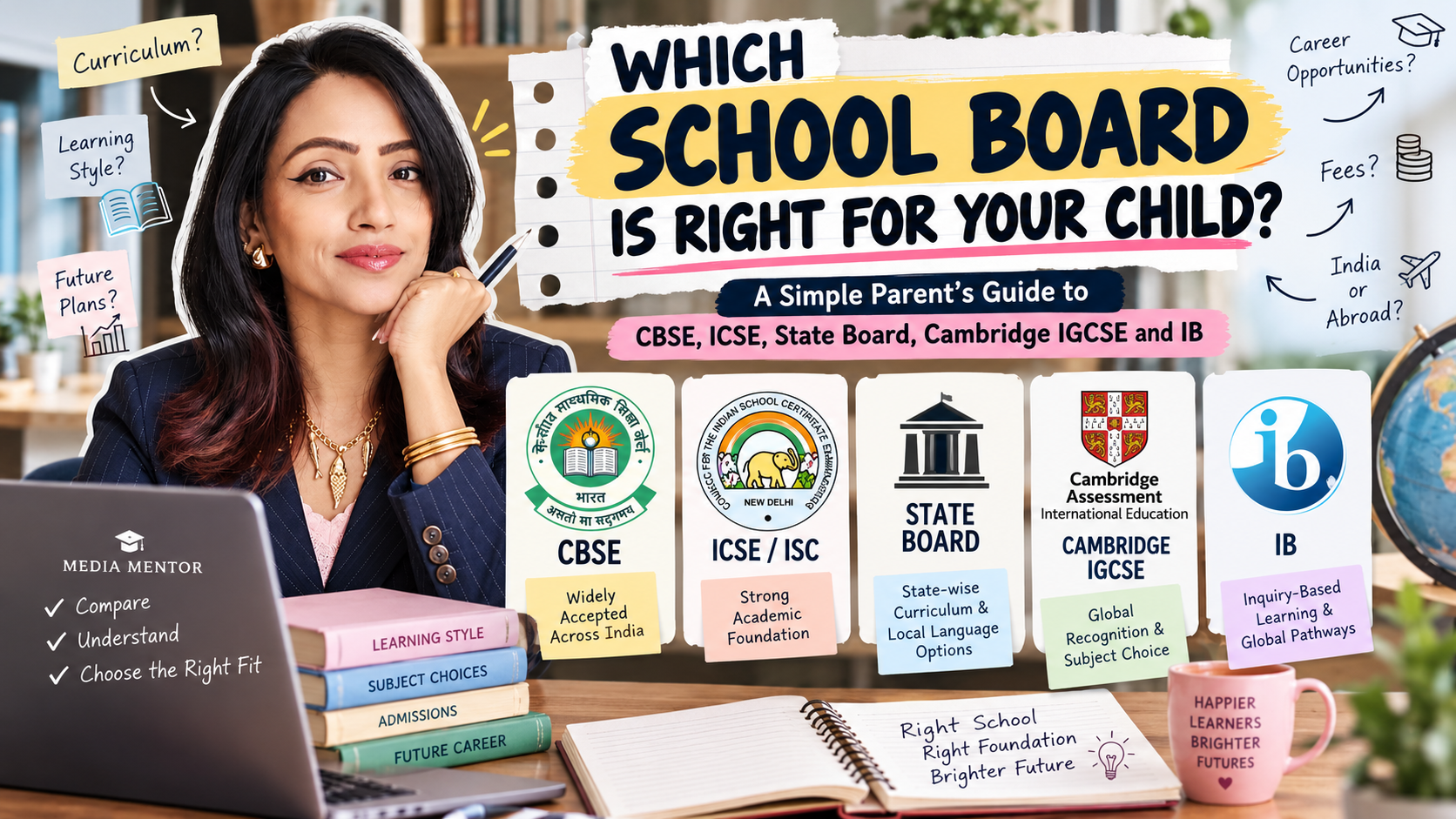
Which School Board Is Right for Your Child? A Quick Comparison
| School Board | May Suit Students Who | What Parents Should Consider |
|---|---|---|
| CBSE | Want a widely available Indian curriculum and continuity when moving between cities | School quality, subject choices and additional entrance-exam preparation |
| ICSE / ISC | Prefer a broad academic curriculum with substantial English-language work | Workload, assessment style and available subjects |
| State Board | Value local-language options or a pathway connected to their state’s education system | State-specific syllabus, language of instruction and transfer requirements |
| Cambridge IGCSE | Prefer subject choice and varied assessment approaches, or are exploring international education | Fees, subject availability and university entry requirements |
| IB | Enjoy inquiry, research, discussion, projects and independent learning | Programme offered, workload, subject combinations and university prerequisites |
| NIOS | Need flexible pacing or an alternative to conventional full-time schooling | Study support, practical requirements and eligibility for future courses |
These are broad guidelines, not guarantees. Two schools following the same board can offer very different teaching quality, student support and learning experiences.
1. CBSE: Central Board of Secondary Education
CBSE is a widely available national school board in India. Many families consider it because schools following the curriculum are available across numerous cities, making continuity easier when families relocate.
CBSE can also be a practical option for students considering Indian competitive examinations. However, choosing CBSE does not automatically ensure success in JEE, NEET or other entrance examinations. Students must check the latest official syllabus and prepare for the relevant examination separately where required.
Potential advantages of CBSE
- A familiar Indian curriculum available across many cities.
- Continuity for families who may relocate within India.
- A pathway that many families consider when planning Indian higher education.
- Multiple school options across different locations and fee ranges.
What parents should check
Look beyond the board name. Review the school’s teaching methods, conceptual understanding, assessment practices, subject combinations for Classes 11 and 12, and support for students preparing for competitive examinations.
Best approach: Consider CBSE if it fits your child’s academic needs and future plans, but evaluate the actual school’s teaching quality before making a decision.
2. ICSE and ISC: Council for the Indian School Certificate Examinations
Parents often compare ICSE with CBSE when choosing a school for their child.
An important distinction is that ICSE refers to the Class 10 examination, while ISC refers to the Class 12 examination conducted by CISCE.
The pathway is often associated with substantial English-language work and a broad academic experience. The actual workload and subject experience, however, depend on the school and the subjects offered.
Potential advantages of the ICSE/ISC pathway
- Exposure to a broad range of academic subjects.
- Opportunities to develop reading, writing and communication skills.
- An academic experience that may appeal to students who enjoy detailed study and written expression.
What parents should check
Review sample textbooks, question papers, internal assessment requirements and the workload expected from students. Also ask which subjects are available in Classes 11 and 12 and how the school supports students with different learning needs.
Best approach: Consider ICSE/ISC if the curriculum, teaching style and available subjects match your child’s strengths and educational plans.
3. State Board: A Practical Option for Many Families
India does not have one common State Board syllabus. Maharashtra, Gujarat, Karnataka and other states have their own boards, rules and examination systems.
For some families, a State Board school may offer convenient access to education, local-language teaching options and continuity within the state’s education system.
Potential advantages of State Boards
- Local-language options, depending on the school.
- Schools located closer to home in many areas.
- A pathway familiar to families planning education within the state.
- Options across different locations and school budgets.
What parents should check
Understand the specific state’s curriculum, language of instruction, examination pattern, transfer requirements and available subjects.
If your child plans to appear for a national entrance examination, compare the board syllabus with the current official entrance-exam syllabus. Additional preparation may be necessary, depending on the subjects and concepts covered.
Best approach: Compare the actual State Board school with other local options rather than assuming that all State Board schools offer the same experience.
4. Cambridge IGCSE: An International Education Pathway
Cambridge IGCSE is an international qualification generally taken around ages 14–16. Cambridge International also offers AS and A Levels for advanced study.
This pathway may appeal to students who value subject choice, varied assessment approaches or the possibility of applying to universities abroad.
Potential advantages of Cambridge IGCSE
- Subject choices that depend on the school’s offering.
- Different assessment approaches across subjects.
- An international qualification pathway for students exploring higher education in different countries.
What parents should check
Cambridge schools can differ in their available subjects, teaching quality and fees. Parents should also consider examination charges, transfer timing and the requirements of universities or professional courses the student may target.
For Indian higher education, do not assume that an international qualification automatically satisfies every university’s admission requirements. Confirm the required subjects, grades and equivalence rules with the relevant authorities.
Official reference: https://www.cambridgeinternational.org/programmes-and-qualifications/recognition-and-acceptance/country/india/
Best approach: Consider Cambridge if its teaching approach and subject choices fit your child, while checking the full cost and future admission requirements in advance.
5. IB: International Baccalaureate
The International Baccalaureate is not a single examination. It offers different programmes for different age groups, including the Primary Years Programme (PYP), Middle Years Programme (MYP) and Diploma Programme (DP).
IB programmes often emphasise inquiry, research, communication, discussion and connections between subjects. They may suit students who enjoy asking questions, exploring ideas and taking an active role in their learning.
Potential advantages of IB
- Opportunities for inquiry-based and interdisciplinary learning.
- Emphasis on research, communication and independent work.
- An international education pathway offered by participating schools.
What parents should check
Not every IB school offers every programme. Before choosing a school, review its teaching quality, subject combinations, student support, workload and fee structure.
For students considering university admission, confirm the subject prerequisites for their intended degree. The programme should support the student’s next educational step rather than being selected only because it has an international reputation.
Official reference: https://www.ibo.org/programmes/
Best approach: Consider IB if your child responds well to inquiry, projects and independent learning, and the school’s programme suits your family’s educational and financial priorities.
6. NIOS: An Alternative for Students Who Need Flexibility
The National Institute of Open Schooling (NIOS) offers open and distance learning, including Secondary and Senior Secondary courses.
Unlike conventional full-time schooling, NIOS can provide greater flexibility in how students organise their studies. It may be worth exploring for learners balancing other commitments or requiring an alternative educational arrangement.
Potential advantages of NIOS
- Flexible study arrangements.
- An alternative to conventional full-time classroom schooling.
- Options for learners who need a different pace or study structure.
What parents should check
NIOS requires planning and self-management. Review the available study support, subject combinations, practical requirements, examination schedules and eligibility rules for the student’s intended college or course.
NIOS states that its Secondary and Senior Secondary certificates are recognised at par with those of other recognised boards. However, eligibility for a particular degree or professional course still depends on that institution’s requirements.
Official reference: https://rcdelhi.nios.ac.in/faqs
Best approach: Explore NIOS when flexibility is an important requirement, and verify the student’s future course eligibility before making a final decision.
7. Which School Board Is Best for Your Child’s Future Career?
Parents often begin by asking which board is best for engineering, medicine, studying abroad or other career pathways. A more useful approach is to start with the student’s possible future goals and work backwards.
If your child is considering engineering or JEE
Compare CBSE, State Board and ICSE/CISCE schools based on mathematics and science teaching, conceptual understanding, subject availability and the time required for entrance-exam preparation.
No school board guarantees a JEE result. The quality of teaching, the student’s preparation and the relevant entrance examination requirements all matter.
If your child is considering medicine or NEET
Confirm that the chosen school offers the required Physics, Chemistry, Biology and English subjects, along with any applicable practical components and eligibility requirements.
Check the current official NEET and counselling rules before selecting subjects or changing boards.
If your child is considering CUET or Indian universities
Begin with the intended course and university. Different programmes can have different subject and eligibility requirements.
Review the latest admission rules and CUET subject mapping rather than choosing a board based on assumptions or social-media claims.
If your child wants to study abroad
Cambridge and IB are familiar international education pathways in many destinations, but Indian board qualifications can also be accepted.
The correct choice depends on the destination country, university, course, subject requirements and qualification criteria. Check the requirements of the specific institutions your child may apply to.
If your child enjoys creative or interdisciplinary subjects
Compare the actual subjects, project opportunities, teacher expertise and scope for independent work offered by each school.
CBSE, ICSE/CISCE, Cambridge and IB schools can all differ considerably. The board label alone should not determine the decision.
If your child needs flexible schooling
Explore NIOS and verify the study arrangements, subject options, practical requirements and eligibility for the intended future course.
8. Eight Things Parents Should Check Before Choosing a School Board
Selecting the right board is only one part of choosing a school. Use these eight steps to make a more informed decision.
1. Understand your child’s learning preferences. Does your child enjoy structured practice, reading, writing, discussion, independent projects or flexible learning? Use these preferences as a guide rather than a fixed label.
2. Consider future educational goals. You do not need to decide a child’s career at an early age. However, for students approaching Classes 9–11, reviewing subject prerequisites for likely pathways can be useful.
3. Compare schools, not just boards. Meet teachers where possible. Ask about class sizes, teacher continuity, learning support, counselling, student safety, transport and extracurricular activities.
4. Review the real workload. Look at sample books, homework, projects, examination papers and a typical weekly timetable. Consider whether the demands are manageable for your child.
5. Calculate the complete cost. Include tuition, admission charges, books, uniforms, transport, technology, trips, examination fees, tutoring and potential annual fee increases.
6. Consider future relocation. If your family may move, check whether the same board and suitable subject combinations will be available in the new location.
7. Confirm recognition and eligibility. For international qualifications, NIOS and unusual subject combinations, seek confirmation from the relevant board, university or entrance authority when the decision affects future admission.
8. Include your child in the discussion. Particularly for older students, discuss learning preferences, stress, interests, friendships and the support they need. The educational environment should fit the child, not the other way around.
9. Questions to Ask Before Taking School Admission
Before finalising a school, consider asking the following questions:
- Which board and programme does the school offer at each grade?
- What subjects and language options are available in Classes 9–10 and 11–12?
- Can we review sample textbooks, question papers and a typical homework schedule?
- How does the school support students who need additional academic help?
- What is the complete annual cost, including examination and activity fees?
- How does the school develop research, communication, problem-solving and digital skills?
- What student wellbeing, counselling and anti-bullying support is available?
- If we change schools or apply to a particular university, what subject requirements and documents should we plan for?
These questions help parents assess the school experience rather than relying solely on its board affiliation.
10. Common Myths About School Boards Parents Should Avoid
Myth 1: An international board automatically offers a better future.
Not necessarily. Teaching quality, student support, subject suitability, effort and available opportunities all influence the educational experience.
Myth 2: CBSE guarantees success in JEE or NEET.
No board guarantees an entrance-exam result. Students must meet the relevant examination requirements and prepare appropriately.
Myth 3: State Board is always easier.
Difficulty varies by state, subject, school, examination and the student’s strengths.
Myth 4: ICSE is only about English.
English-language work is a notable feature of many CISCE schools, but parents should evaluate the entire curriculum, subject choices and workload.
Myth 5: NIOS certificates are not valid.
NIOS states that its Secondary and Senior Secondary certificates are recognised at par with those of other recognised boards. Students must still verify the specific eligibility requirements of their intended course or institution.
Myth 6: Changing boards is simple at any stage.
A change may affect subjects, language, assessment patterns, credits or admission eligibility. Check the implications before transferring, especially in Classes 9–12.
11. The Parent’s School Board Decision Checklist
Before making a final decision, ask yourself:
- Does the curriculum match my child’s current learning needs?
- Have we evaluated the actual school’s teachers and support system?
- Are the required subjects available for possible future courses?
- Have we compared the full annual cost?
- Do we understand the examination pattern and expected workload?
- Have we considered our family’s location and potential relocation?
- Have we verified recognition and eligibility requirements where necessary?
- Has my child had an opportunity to share their preferences?
Use this checklist to guide a discussion, not to calculate a universal winner. More than one board may be suitable for your child.
Media Mentor’s Final Advice: Choose the Right Fit, Not Just the Right Reputation
The best school board is not necessarily the one with the highest-profile reputation, the most expensive school or the strongest claims on social media.
For younger children, teaching quality, emotional safety, reading habits and a positive relationship with learning are particularly important. As students approach Classes 9–12, subject combinations, assessment styles, workload and eligibility for higher education become increasingly relevant.
Before deciding, compare the actual schools available to your family, understand your child’s needs and verify the requirements for the next educational step.
At Media Mentor, we believe informed education decisions begin with asking the right questions. Choose a learning environment that helps your child build strong foundations, remain curious, feel supported and keep appropriate future options open.
For official guidance, consult the relevant education authorities and boards:
- NCERT PARAKH — Equivalence of Boards: https://parakh.ncert.gov.in/equivalence-of-boards
- CBSE Academic: https://cbseacademic.nic.in/
- Cambridge International — Recognition in India: https://www.cambridgeinternational.org/programmes-and-qualifications/recognition-and-acceptance/country/india/
- NIOS: https://rcdelhi.nios.ac.in/faqs
- International Baccalaureate: https://www.ibo.org/programmes/
- CISCE: https://cisce.org/
Disclaimer: Board rules, subject combinations, equivalence requirements and admission policies may change. Verify the latest official guidance from the relevant board and target university or entrance authority before making a final decision. This article is intended for general educational guidance and does not guarantee admission.
SEO settings for Media Mentor
Focus keyword: Which school board is best for your child
SEO title: Which School Board Is Best? CBSE vs ICSE vs IB vs IGCSE
URL slug: which-school-board-is-best-for-your-child
Meta description: Compare CBSE, ICSE, State Board, Cambridge IGCSE, IB and NIOS to choose the right school board for your child’s learning style and future goals.
Secondary keywords:
- CBSE vs ICSE
- Best school board in India
- CBSE vs ICSE vs IB
- Cambridge IGCSE vs CBSE
- IB vs CBSE
- How to choose a school board
- School board comparison for parents
- State Board vs CBSE
Suggested WordPress tags: CBSE, ICSE, State Board, Cambridge IGCSE, IB Board, NIOS, School Admissions, Parenting Guide, Education in India, Media Mentor
Suggested featured image alt text: Which school board is best for your child – CBSE, ICSE, State Board, IB and Cambridge IGCSE comparison
Suggested internal links: Link to relevant Media Mentor articles about school admissions, choosing a school, entrance examinations and education planning wherever those articles are available on your website.