
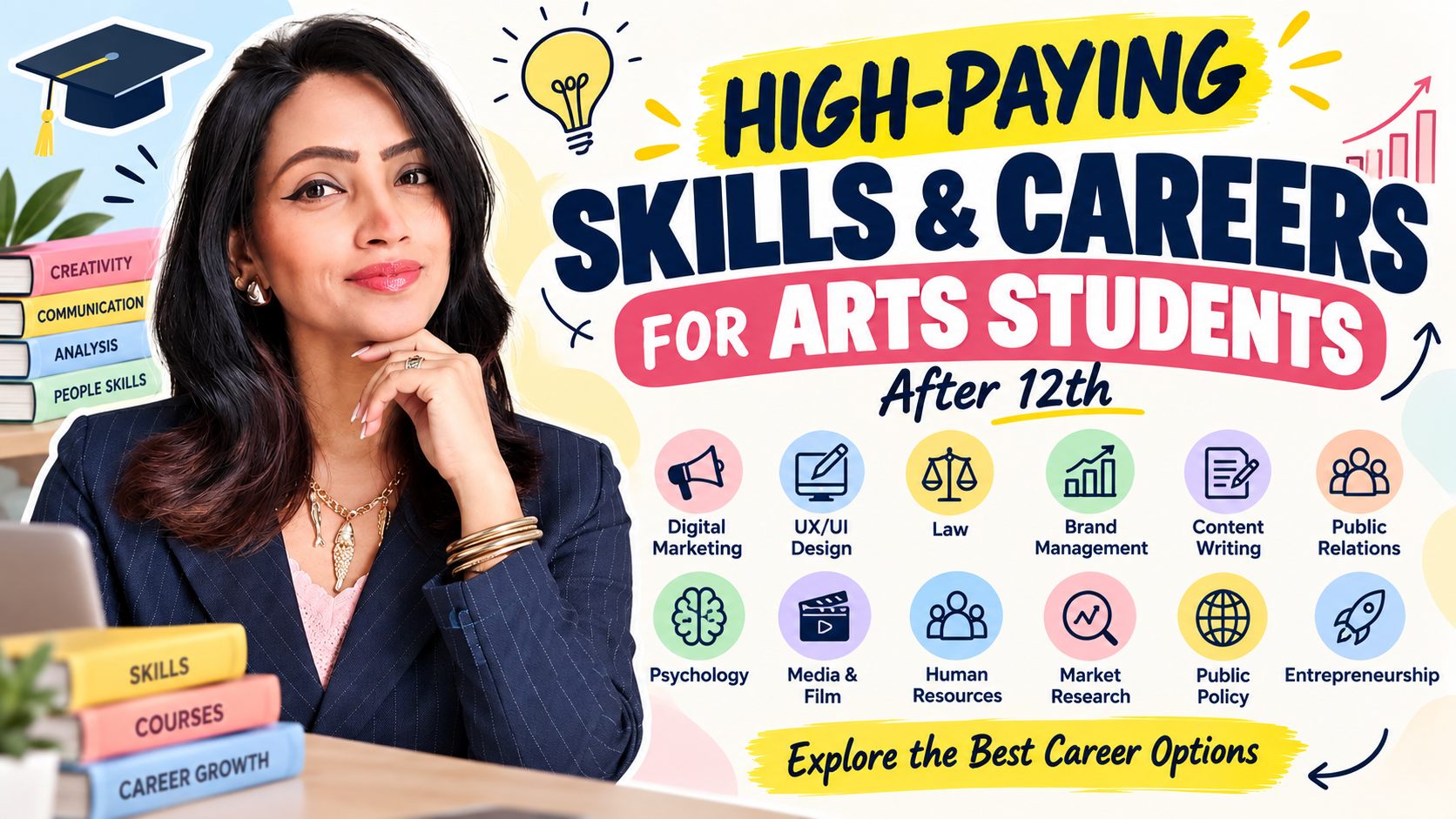
Choosing Arts after Class 10 does not mean limiting your career opportunities. From digital marketing and UX design to corporate law, brand management and psychology, Arts students can explore careers across industries that value creativity, communication, research and problem-solving.
But here is something every student should understand: a high-paying career is not determined by your Class 12 stream alone. It depends on the skills you build, the qualifications you earn, the experience you gain and the value you bring to an organisation.
Some careers require a specialised degree and years of professional training. Others allow you to develop practical skills, build a portfolio and gain experience while pursuing your graduation.
So, which are the best high-paying careers for Arts students after 12th? Which skills should you learn? And how do you choose a career that offers both financial growth and long-term opportunities?
In this Media Mentor guide, we explore 12 promising career options for Arts students, the skills and courses associated with each, potential career paths and practical steps you can take to get started.
Quick Answer: What Are the Best High-Paying Careers for Arts Students?
Some promising career options for Arts students after Class 12 include:
- Digital Marketing and Performance Marketing
- UX/UI Design and User Research
- Corporate Law
- Brand Management and Advertising
- Content Strategy and Copywriting
- Public Relations and Corporate Communications
- Psychology and Behavioural Research
- Film and Media Production
- Human Resources and Talent Acquisition
- Market Research and Business Insights
- Public Policy and International Relations
- Freelancing and Entrepreneurship
The right career depends on your interests, strengths, preferred working style, educational qualifications and willingness to develop specialised skills.
Let’s explore these options in detail.
1. Digital Marketing and Performance Marketing
Best for: Students who enjoy social media, advertising, communication, consumer behaviour and analysing trends.
Digital marketing is a promising career option for Arts students because it combines creativity with business strategy and technology.
Businesses need professionals who can attract customers, build brand awareness, create campaigns and measure how effectively their marketing investments perform.
Skills to learn
- Search Engine Optimisation (SEO)
- Social media marketing
- Google Ads and paid advertising
- Content marketing
- Email marketing
- Website analytics
- Campaign reporting and optimisation
Courses after 12th
You can pursue a BA in Mass Communication, Journalism or Advertising, a BBA in Marketing, or another relevant undergraduate degree. You can also develop digital marketing skills through reputable certification programmes and practical projects.
Career opportunities
You can begin as a Digital Marketing Executive, SEO Specialist, Social Media Executive or Performance Marketing Executive. With experience, you may progress into growth marketing, campaign strategy or digital marketing management.
What influences your earning potential?
Professionals who understand campaign performance, customer acquisition, analytics and return on advertising spend can develop valuable expertise.
Media Mentor tip: Do not limit yourself to learning how to create social media posts. Learn how to understand an audience, plan campaigns, interpret analytics and connect marketing activity to business outcomes.
2. UX/UI Design and User Research
Best for: Students interested in design, human behaviour, problem-solving and technology.
User Experience (UX) and User Interface (UI) design focus on making websites, mobile applications and digital products easier to use.
Arts students may find this field interesting because it draws on empathy, observation, communication, visual thinking and an understanding of how people interact with products.
Skills to learn
- User research and interviews
- Wireframing and prototyping
- Information architecture
- Interaction design
- Usability testing
- Accessibility principles
- Design tools such as Figma
Courses after 12th
Explore relevant programmes in communication design, interaction design, product design or other design disciplines. Some institutions have specific entrance examinations, portfolios or subject requirements, so check eligibility before applying.
Career opportunities
- UX Designer
- UI Designer
- UX Researcher
- Interaction Designer
- Product Designer
- Design Strategist
How can you stand out?
Build a portfolio that explains the problem you identified, how you researched users, the design decisions you made and how you tested your solution.
A portfolio demonstrating your thinking and problem-solving can be particularly valuable when applying for design roles.
3. Corporate Law and Legal Careers
Best for: Students who enjoy reading, debating, analysing information and understanding business, rules and public institutions.
Law offers a structured professional pathway for Arts students interested in legal practice, business, contracts, compliance or litigation.
Skills to develop
- Legal research
- Analytical reasoning
- Drafting and documentation
- Negotiation
- Communication and presentation
- Attention to detail
- Commercial awareness
Courses after 12th
Eligible students can explore integrated undergraduate programmes such as BA LLB and BBA LLB.
Admission requirements differ by institution. Depending on your target colleges, you may need to prepare for examinations such as CLAT, AILET or university-specific entrance tests.
Career opportunities
- Corporate Lawyer
- Legal Associate
- Litigation Lawyer
- Contract Management Specialist
- Compliance Professional
- Legal Researcher
- In-house Legal Counsel
What should you consider before choosing law?
Law can involve substantial investment in education and several years of professional development. Compare college fees, internships, recruitment opportunities, alumni outcomes and the areas of law that interest you.
Some competitive corporate law firms offer attractive compensation to selected graduates, but salaries vary considerably by institution, employer, location and experience.
Media Mentor tip: Choose law because you are interested in the work and prepared for the training it requires—not simply because you have heard that lawyers earn well.
4. Brand Management and Advertising
Best for: Students who enjoy creativity, consumer psychology, communication and business strategy.
Brand management involves understanding what customers value and helping businesses communicate why their products or services matter.
Professionals work on brand positioning, advertising campaigns, customer research, market trends and communication strategy.
Skills to learn
- Consumer behaviour
- Market research
- Brand positioning
- Advertising strategy
- Storytelling and presentation
- Campaign planning
- Marketing analytics
Courses after 12th
Relevant options include BA in Advertising, Journalism or Mass Communication, BBA in Marketing, and other undergraduate programmes that develop marketing and business skills.
Career opportunities
- Brand Executive
- Advertising Executive
- Account Executive
- Marketing Communications Specialist
- Consumer Insights Analyst
- Brand Manager, with relevant experience
What drives career growth?
Successful brand professionals combine creativity with commercial understanding. They know how to research customers, position a product, develop a campaign and assess its effectiveness.
If you enjoy understanding why people choose one brand over another, this field may be worth exploring.
5. Content Strategy, Copywriting and Creative Writing
Best for: Students who enjoy writing, storytelling, research, language and communication.
Every business needs to explain what it offers and why customers should care. This creates opportunities for writers and content professionals across websites, advertising, education, media and technology.
However, high-value content work involves more than writing grammatically correct sentences. It requires understanding audiences, brand positioning, search intent and business objectives.
Skills to learn
- Copywriting and storytelling
- SEO content writing
- Content strategy
- Research and fact-checking
- Brand voice development
- Video scripting
- Editorial planning
- AI-assisted editing and quality control
Courses after 12th
You can consider BA in English, Journalism, Mass Communication or related subjects. Practical courses and independent projects can help you build specialised skills alongside your degree.
Career opportunities
- Copywriter
- SEO Content Writer
- Content Strategist
- Scriptwriter
- Editorial Executive
- Creative Writer
- Creative Director, with relevant experience
How can you build a portfolio?
Create examples of different types of work, such as:
- An SEO-optimised website article
- A landing page for a product or service
- An advertising campaign concept
- A short-form video script
- A content calendar for a brand
Label self-initiated projects honestly and explain the thinking behind your work.
Media Mentor tip: Students who combine writing with SEO, audience research, strategy and editing can explore a wider range of opportunities than those who focus only on basic content production.
6. Public Relations and Corporate Communications
Best for: Students interested in media, current affairs, communication, networking and reputation management.
Public relations professionals help organisations communicate with journalists, customers, employees, investors and the public.
Their work may include media relations, press releases, events, executive communication, crisis management and reputation-building campaigns.
Skills to develop
- Professional writing
- Media relations
- Public speaking
- Crisis communication
- Research and fact-checking
- Event coordination
- Stakeholder management
- Communication reporting
Courses after 12th
Explore BA in Journalism and Mass Communication, Public Relations or other communication-related programmes.
Career opportunities
- PR Executive
- Corporate Communications Executive
- Media Relations Specialist
- Reputation Management Consultant
- Internal Communications Specialist
- Communications Manager, with experience
Why can Arts students be a good fit?
An understanding of language, culture, public opinion and social behaviour can help communication professionals develop messages that resonate with different audiences.
Internships, writing samples and practical exposure to media campaigns can help you demonstrate your abilities.
7. Psychology and Behavioural Research
Best for: Students interested in human behaviour, research, mental processes and understanding how people think and act.
Psychology offers opportunities in research, education, organisational development and several specialised professional pathways.
However, studying psychology does not automatically qualify someone to practise in every psychology-related profession.
Skills to develop
- Research methods
- Statistical literacy
- Observation and interviewing
- Ethical decision-making
- Report writing
- Active listening
- Understanding psychological assessments
Courses after 12th
You can explore BA or BSc Psychology, depending on the programmes offered and your eligibility.
Some careers require postgraduate education, supervised training, recognised qualifications or professional registration. Students interested in clinical psychology should verify the latest applicable requirements and approved training pathways before choosing a course.
Career opportunities
- Psychology Research Assistant
- Behavioural Researcher
- Organisational Behaviour Professional
- HR Specialist
- Educational Support Professional
- Counselling or clinical pathways, subject to applicable qualifications
Is psychology a high-paying career?
Earning potential varies considerably according to qualifications, specialisation, employer and experience. Research support roles, organisational positions and specialised professional practice follow different career paths.
Choose psychology because you are interested in the subject and prepared for the qualifications required for your intended role.
8. Film, Media Production and Creative Direction
Best for: Students who enjoy filmmaking, visual storytelling, editing, photography and creative projects.
The growth of digital video, streaming platforms, online education and branded content has created opportunities for people who can develop and produce compelling visual stories.
Arts students can explore both creative and operational roles within the media industry.
Skills to learn
- Video editing
- Scriptwriting
- Cinematography fundamentals
- Production planning
- Visual storytelling
- Sound and lighting basics
- Creative research
- Project management
Courses after 12th
Relevant options include BA in Film Studies, Film Production, Mass Communication or other media-related programmes.
Practical workshops, student productions and independent projects can complement formal education.
Career opportunities
- Video Editor
- Assistant Director
- Production Coordinator
- Scriptwriter
- Content Producer
- Creative Strategist
- Film or Advertising Director, with relevant experience
How can you get started?
Create short films, edit sample videos, participate in student productions or develop branded-content concepts.
A strong portfolio can help demonstrate your creative judgement, technical ability and understanding of the production process.
9. Human Resources and Talent Acquisition
Best for: Students who enjoy communication, teamwork, organisational behaviour and working with people.
Human resources professionals support recruitment, employee engagement, training, workplace policies and organisational development.
Arts students can explore this field through management, psychology and other relevant undergraduate programmes.
Skills to develop
- Interviewing and recruitment
- Professional communication
- HR documentation
- Employee engagement
- Conflict resolution
- Data interpretation
- Recruitment technology
- Project coordination
Courses after 12th
Possible pathways include BBA, BA Psychology and other relevant undergraduate degrees. Specialised HR qualifications may help with certain roles and career progression.
Career opportunities
- Talent Acquisition Executive
- HR Executive
- Recruitment Consultant
- Learning and Development Coordinator
- People Operations Specialist
- HR Business Partner, with experience
How can you improve your prospects?
Develop communication skills alongside spreadsheet proficiency, recruitment technology and an understanding of workplace policies.
Professionals who combine people skills with analytical ability may be better positioned for specialised HR and people-management roles.
10. Market Research and Consumer Insights
Best for: Students who enjoy research, understanding customer behaviour, analysing trends and solving business problems.
Businesses need to understand what customers want, how markets are changing and why people choose particular products.
Market research and consumer insights professionals gather information, analyse findings and communicate recommendations that help organisations make decisions.
Skills to learn
- Survey design
- Research methodology
- Basic statistics
- Excel and spreadsheet analysis
- Consumer behaviour
- Data visualisation
- Report writing
- Presentation skills
Courses after 12th
Relevant pathways include Economics, Psychology, Sociology, Business and other degrees with appropriate research and analytical components.
Check mathematics and statistics prerequisites for programmes that require them.
Career opportunities
- Market Research Executive
- Consumer Insights Analyst
- Research Associate
- Business Research Analyst
- Social Researcher
- Marketing Analyst
What makes this field interesting?
It combines an understanding of people with evidence-based decision-making. Students who enjoy asking questions, identifying patterns and explaining what the data means may find this field rewarding.
11. Public Policy and International Relations
Best for: Students interested in politics, economics, society, international affairs and public administration.
Public policy and international relations offer pathways for students who want to understand how governments, institutions and societies operate.
Professionals in these fields may work in research, consulting, development programmes, public affairs or policy analysis.
Skills to develop
- Research and policy analysis
- Critical thinking
- Report writing
- Data interpretation
- Economics and political analysis
- Presentation skills
- Stakeholder communication
Courses after 12th
Explore Political Science, Economics, Sociology, International Relations, Public Administration and related undergraduate programmes.
Some specialist roles require postgraduate qualifications or additional professional experience.
Career opportunities
- Policy Research Assistant
- Research Associate
- Programme Coordinator
- Public Affairs Executive
- Development Sector Professional
- Policy Consultant, with relevant experience
What should students know?
Earning potential varies widely across government, research institutions, nonprofit organisations, consulting firms and international organisations.
Research the actual work, qualification requirements and employment opportunities before choosing this path.
12. Freelancing and Entrepreneurship
Best for: Students who enjoy building projects, solving problems, communicating ideas and taking initiative.
Arts students can also build independent careers by offering services, developing digital products, starting agencies or creating businesses.
Potential areas include content writing, design, digital marketing, video production, tutoring and communication consulting.
Skills to learn
- Sales and client communication
- Project management
- Pricing and negotiation
- Personal branding
- Financial planning
- Digital marketing
- Customer research
- Business development
Career opportunities
- Freelance Copywriter
- Social Media Consultant
- Independent Designer
- Content Creator
- Creative Agency Founder
- Education Entrepreneur
- Marketing Consultant
How much can you earn?
There is no fixed salary range for freelancing or entrepreneurship. Income depends on your services, client base, pricing, business expenses, reputation and ability to generate repeat work.
Start by mastering one marketable skill, creating a portfolio and working on manageable projects. Learn to price your work and manage cash flow before making substantial financial commitments.
Media Mentor tip: Entrepreneurship is not a shortcut to earning more. It involves uncertainty, client acquisition, financial responsibility and consistent execution.
Comparison: Which Career Should Arts Students Choose?
Use this table to compare career paths by the type of work involved and the skills you may need.
| Career | Primary focus | Skills to prioritise |
|---|---|---|
| Digital Marketing | Campaigns and customer acquisition | SEO, advertising, analytics |
| UX/UI Design | Digital product experiences | Research, design, prototyping |
| Corporate Law | Legal practice and business matters | Research, drafting, analysis |
| Brand Management | Positioning and marketing strategy | Consumer insights, communication |
| Content Strategy | Writing and content planning | SEO, storytelling, research |
| Public Relations | Media and reputation | Writing, media relations |
| Psychology | Behaviour and research | Research, ethics, statistics |
| Film and Media | Visual storytelling and production | Editing, scripting, production |
| Human Resources | Recruitment and people management | Communication, recruitment tools |
| Market Research | Customer and market insights | Research, statistics, Excel |
| Public Policy | Research and public affairs | Analysis, writing, data interpretation |
| Entrepreneurship | Building an independent business | Sales, marketing, financial planning |
There is no universally best career for Arts students. A good choice is one that matches your strengths, offers a realistic entry pathway and gives you opportunities to develop valuable expertise.
High-Paying Careers for Arts Students: What About Salary?
Students often search for the highest-paying jobs after Class 12 Arts. It is important to distinguish between the salary a beginner may receive and the earning potential of an experienced professional.
A high-paying role may require specialised qualifications, strong practical skills, a competitive recruitment process or several years of experience.
Before choosing a course, investigate:
- Entry-level salaries for the specific role.
- Placement outcomes from the colleges you are considering.
- Internship opportunities and industry connections.
- Qualifications required for career progression.
- Fees and the likely cost of education.
- Whether the career has opportunities in your preferred location.
Do not judge a career only by the highest package advertised by a college or mentioned in a social media post. Ask whether the figure represents a typical outcome, an exceptional offer or a role requiring substantial experience.
The smartest career decision balances earning potential, personal fit, education costs and realistic employment opportunities.
Degree vs Skills: What Matters More for Arts Students?
One of the most common questions students ask is whether they should focus on a college degree or learn practical skills.
The answer depends on the profession.
Careers requiring recognised qualifications
Law and regulated psychology-related pathways have specific educational and professional requirements. You must verify the applicable qualifications before entering professional practice.
Careers where degrees and practical skills work together
Brand management, public relations, human resources, market research and media production often benefit from a combination of formal education and practical experience.
Careers where portfolios can be particularly valuable
Copywriting, digital marketing, video editing and some design roles may place considerable emphasis on demonstrable skills and work samples.
A degree may still be preferred or required by particular employers.
For many students, the strongest strategy is to combine a relevant undergraduate degree with practical projects, internships and job-ready skills.
This approach allows you to develop academic knowledge while gaining experience that can help you understand the workplace.
A Practical 6-Month Skill-Building Roadmap for Arts Students
You do not need to master every skill at once. If you are unsure where to begin, use this roadmap to explore one career direction.
Month 1: Explore your interests
Shortlist three careers that match your interests. Read job descriptions, research courses and speak with people studying or working in those fields.
Month 2: Choose one skill
Select a relevant skill, such as SEO, copywriting, design, video editing or market research.
Avoid enrolling in multiple unrelated courses simply because they are popular.
Month 3: Learn the fundamentals
Complete a structured beginner course and practise regularly. Focus on understanding how the skill is used in real work.
Month 4: Build a portfolio
Create three to five relevant projects. For example, a digital marketing student could prepare a sample campaign, a keyword research report and a content plan.
Clearly identify practice projects as self-initiated work.
Month 5: Seek practical experience
Explore suitable internships, student projects, volunteering opportunities or supervised freelance assignments.
Use feedback to improve your work.
Month 6: Prepare for opportunities
Create a professional CV, organise your portfolio and practise explaining your work. Apply for relevant internships and entry-level opportunities when eligible.
This roadmap is a starting point rather than a substitute for formal education. Careers such as law and regulated professional practice require their own qualification pathways.
6 Mistakes Arts Students Should Avoid While Choosing a Career
1. Choosing a career only because it sounds high-paying
A career may have strong earning potential but still be unsuitable for your interests, abilities or preferred working style.
2. Collecting certificates without practical experience
Certificates can support your learning, but projects, internships and demonstrable skills help show what you can actually do.
3. Ignoring digital literacy
Communication, research, spreadsheets, presentations and responsible use of digital tools can improve your effectiveness across many professions.
4. Believing every salary claim online
Exceptional packages and success stories do not represent every graduate’s experience. Verify salary claims through multiple job listings and credible placement information.
5. Choosing a college without researching outcomes
Compare curriculum, faculty, fees, internships, alumni careers and placement reports where available.
6. Waiting until graduation to explore careers
Build projects and seek practical exposure when your schedule and eligibility allow. Early exploration can help you make better-informed decisions about further education.
Frequently Asked Questions About High-Paying Careers for Arts Students
1. Can Arts students earn ₹10 lakh per annum?
Yes, some Arts graduates and experienced professionals earn ₹10 lakh per annum or more. However, this is not a guaranteed starting salary. Earnings depend on the profession, qualifications, skills, employer, experience and job responsibilities.
2. Which skill is best for Arts students after 12th?
There is no single best skill for every student. Digital marketing may suit students interested in advertising and business, copywriting may suit strong writers, and UX design may suit those interested in design and user behaviour. Choose a skill based on your interests and the requirements of your preferred career.
3. Can Arts students enter the technology industry?
Yes. Arts graduates can explore UX research, content design, digital marketing, product communications and selected design roles. Some technical positions require additional mathematics, programming or specialised qualifications.
4. Can Arts students pursue law after Class 12?
Yes. Eligible students can apply for integrated undergraduate law programmes such as BA LLB and BBA LLB. Admission requirements differ by institution and entrance examination.
5. Can Arts students become psychologists?
Yes. Students can study psychology after Class 12, subject to programme eligibility. However, clinical practice and other regulated or specialised roles may require specific postgraduate qualifications, supervised training or professional registration.
6. Is digital marketing a good career for Arts students?
Digital marketing can be a promising option because it combines communication, creativity, consumer behaviour and analytics. Career progression depends on practical expertise, performance and the ability to deliver results.
7. Is a degree necessary for a high-paying career?
Some professions require recognised qualifications, while others place considerable emphasis on practical skills and portfolios. A relevant degree combined with work experience can provide a strong foundation, but the right pathway depends on your chosen profession.
8. What can Arts students do while studying in college?
Students can build portfolios, learn relevant tools, participate in projects, complete suitable certifications, volunteer and seek internships. Prioritise experiences that support your career goals rather than collecting unrelated certificates.
Final Thoughts: Your Stream Does Not Define Your Earning Potential
Choosing Arts after Class 10 does not mean giving up on a financially rewarding future.
It means exploring a different set of academic and professional pathways. With the right qualifications, practical skills, experience and career planning, Arts students can build careers across media, business, law, design, psychology, research and entrepreneurship.
The most important decision is not simply which career pays the most today. It is which pathway gives you a realistic opportunity to develop valuable expertise, find meaningful work and grow over time.
At Media Mentor, we believe students deserve honest, practical education and career guidance—not generic advice or unrealistic promises.
Before committing to a course, understand the work involved, compare college options, investigate fees and eligibility, and identify the skills you can begin developing today.
Explore your strengths. Build valuable skills. Choose your career with clarity.
Media Mentor — Honest, student-focused guidance for your education and career journey.
Disclaimer: Career outcomes and salaries vary according to qualifications, employer, location, skills and experience. This article is intended for general educational guidance and does not guarantee employment or earnings. Verify course eligibility, professional requirements, fees and admission details with the relevant institutions and authorities before making a decision.