
By Media Mentor | Career Guidance & Student Success
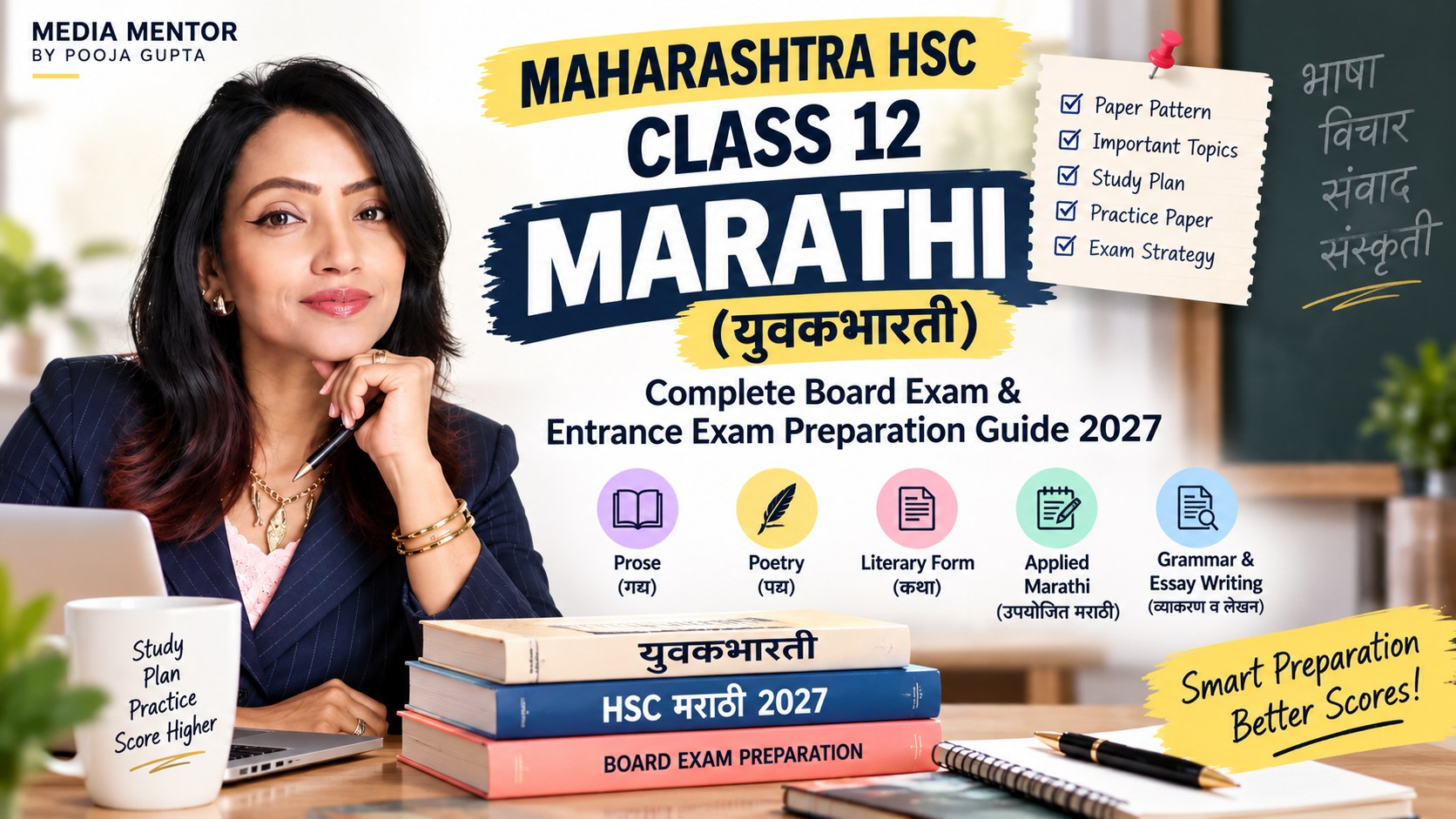
Marathi is not a subject to leave until the final week. With a clear revision plan, regular writing practice and a good understanding of the syllabus, students can improve their comprehension, presentation and confidence. This guide covers the Maharashtra HSC Class 12 Marathi (युवकभारती) paper-pattern reference, preparation strategies, a sample practice paper, and a four-week revision plan.
Important for HSC 2027: The marks distribution below reflects the 2026 paper structure and is provided as a planning reference only. It is not confirmation of the final 2027 pattern. Check the latest syllabus and examination instructions issued by the Maharashtra State Board of Secondary and Higher Secondary Education (MSBSHSE).
Maharashtra HSC Marathi Exam 2027: At a Glance
| Exam detail | Information |
|---|---|
| Class | HSC Class 12 |
| Subject | Marathi – युवकभारती |
| Written examination | 80 marks in the 2026 reference structure |
| Internal assessment | 20 marks in the 2026 reference structure |
| Total subject marks | 100 in the 2026 reference structure |
| Written-paper duration | 3 hours in the 2026 reference structure |
| Preparation areas | Prose, poetry, literary form, applied Marathi, grammar and essay writing |
Verify the final 2027 syllabus and paper pattern with official Maharashtra Board notifications and your college. If the board issues a revised structure, follow the latest official instructions.
Maharashtra HSC Marathi Paper Pattern: Section-Wise Preparation
The following breakdown reflects the 2026 paper structure. Confirm the final 2027 distribution before using it for exam planning.
1. Prose (गद्य) — 20 marks
| Component | Marks |
|---|---|
| Prescribed prose passage and activities | 8 |
| Another prescribed prose passage and activities | 8 |
| Unseen prose passage | 4 |
| Total | 20 |
How to prepare
- Read every prescribed lesson and identify its central idea, important events, characters and message.
- Practise comprehension and personal-opinion questions.
- Answer unseen-passage questions using evidence from the passage.
- Write complete, relevant answers without adding unrelated information.
2. Poetry (पद्य) — 16 marks
| Component | Marks |
|---|---|
| Prescribed poem: comprehension and appreciation | 8 |
| Explanation of poetic lines | 4 |
| Poetic appreciation / रसग्रहण | 4 |
| Total | 16 |
How to prepare
- Understand the central thought, tone and emotion of each prescribed poem.
- Learn the poet’s name and poetic features required by your syllabus.
- Practise explaining lines in simple, accurate Marathi.
- Support appreciation answers with relevant references. Do not guess a poetic device or interpretation.
3. Literary Form: Story (साहित्यप्रकार: कथा) — 10 marks
| Component | Marks |
|---|---|
| Activities based on the literary form | 4 |
| Descriptive or personal-response question | 6 |
| Total | 10 |
Learn the characteristics of a short story and revise plot, characters, setting, conflict and conclusion. Connect these features to prescribed lessons rather than memorising definitions in isolation. Structure longer answers with a clear point, explanation and relevant example.
4. Applied Marathi (उपयोजित मराठी) — 14 marks
| Component | Marks |
|---|---|
| Short applied-writing activity | 4 |
| Extended applied-writing activity | 10 |
| Total | 14 |
Depending on the prescribed syllabus and question paper, practise formats such as:
- Interview writing (मुलाखत)
- Brochure writing (माहितीपत्रक)
- Report writing (अहवाल लेखन)
- News or feature writing (वृत्तलेखन)
Scoring tip: Learn the format of each task. Include an appropriate heading, relevant details, logical sequencing and suitable language. Follow the question’s instructions and word limit.
5. Grammar and Essay Writing (व्याकरण व लेखन) — 20 marks
| Component | Marks |
|---|---|
| Grammar activities | 10 |
| Essay writing | 10 |
| Total | 20 |
Grammar revision may include syllabus topics such as sentence types and transformation (वाक्यप्रकार व वाक्यरूपांतर), compound words (समास), प्रयोग, figures of speech (अलंकार) and idiomatic expressions (वाक्प्रचार).
Essay questions may involve descriptive, imaginative, autobiographical or argumentative writing, depending on the prescribed syllabus. Practise grammar through written examples. For essays, prepare ideas and examples across several themes, then answer the exact topic in the examination.
Marks Summary
| Section | Marks in the 2026 structure |
|---|---|
| Prose | 20 |
| Poetry | 16 |
| Literary form: Story | 10 |
| Applied Marathi | 14 |
| Grammar and essay writing | 20 |
| Written paper total | 80 |
| Internal assessment | 20 |
| Subject total | 100 |
This is a reference to the 2026 structure, not a guarantee of the 2027 paper pattern.
Media Mentor’s Marathi Board Exam Preparation Strategy
1. Understand before memorising
Read the lesson first. Identify its meaning, key events, central message and important details. Understanding makes it easier to answer questions phrased in unfamiliar ways.
2. Use keywords to revise long answers
Note four or five key points for each long answer. Close the book and reconstruct the answer in your own words, then check that you covered the important points.
3. Practise writing, not just reading
Reading model answers alone will not build writing speed, spelling accuracy or presentation. Write answers regularly and review them for clarity, relevance and grammar.
4. Keep a notebook of writing formats
Create a quick-reference notebook for interviews, reports, brochures and other applied-writing formats in your syllabus. Practise each format more than once.
5. Use previous-year papers strategically
Practise recent available papers, including 2026 and 2025 where available. Use them to understand question styles, practise timing and identify weak areas. A question appearing in a past paper is not a guarantee that it will repeat.
Maharashtra HSC Marathi Sample Practice Paper
Class: HSC Class 12
Subject: Marathi – युवकभारती
Maximum marks: 80, based on the reference structure
Suggested practice time: 3 hours
This is an original Media Mentor practice resource, not an official Maharashtra Board question paper. The structure and marks below refer to the 2026 pattern and must be checked against the final 2027 instructions. For prescribed-text questions, use your current textbook.
Section 1: Prose — 20 marks
Q1. Read the passage and complete the activities.
“वाचन ही केवळ परीक्षा उत्तीर्ण होण्याची प्रक्रिया नाही. वाचनामुळे माणसाच्या विचारांना दिशा मिळते. पुस्तकांमधून आपल्याला विविध अनुभव, संस्कृती आणि जीवनमूल्ये समजतात. नियमित वाचनामुळे भाषेवर प्रभुत्व मिळते आणि स्वतःचे विचार प्रभावीपणे मांडता येतात. मोबाईल आणि इंटरनेटच्या युगातही पुस्तकांचे महत्त्व कमी झालेले नाही. योग्य वाचनाची सवय विद्यार्थ्यांना अभ्यासात तसेच जीवनात मदत करते.”
- Complete the statements. (2 marks)
a. वाचनामुळे माणसाच्या __________ दिशा मिळते.
b. नियमित वाचनामुळे भाषेवर __________ मिळते. - State two benefits of reading mentioned in the passage. (2 marks)
- Explain in your own words why reading remains important in the digital age. (4 marks)
Q2. Prescribed prose lesson — 8 marks
- Complete a comprehension activity based on a prescribed passage. (2 marks)
- Explain an important idea or event from the lesson. (2 marks)
- Express your opinion about the lesson’s message, giving reasons. (4 marks)
Q3. Unseen prose — 4 marks
Prepare a second short unseen passage and answer two comprehension questions worth 2 marks each.
Section 2: Poetry — 16 marks
Q4. Prescribed poem — 8 marks
- Complete two comprehension activities based on the poem. (4 marks)
- Explain its poetic beauty, imagery or central emotion with relevant examples. (4 marks)
Q5. Explanation of poetic lines — 4 marks
Select two lines from a prescribed poem. Explain their meaning in simple Marathi, identifying the central thought and emotion.
Q6. Poetic appreciation — 4 marks
Write a brief appreciation of a prescribed poem, covering its central idea, poetic expression and message.
Section 3: Literary Form — Story — 10 marks
Q7. Answer the following
- State two characteristics of a short story. (4 marks)
- Explain how characters, plot and conclusion contribute to the impact of a story you have studied. (6 marks)
Use the literary terminology and prescribed lessons in your current textbook.
Section 4: Applied Marathi — 14 marks
Q8. Short applied-writing activity — 4 marks
Prepare a brief report on a tree-plantation programme organised by your college. Include the event, participants and outcome.
Q9. Extended applied-writing activity — 10 marks
Write a brochure for a college reading festival. Include an attractive heading, the purpose of the event, activities and competitions, date and venue, participation details, and a clear invitation to students. Follow the format and word limit specified in the question.
Section 5: Grammar and Essay Writing — 20 marks
Q10. Grammar — 10 marks
- Identify or transform a sentence according to the instruction. (2 marks)
- Identify the compound word and its type. (2 marks)
- Identify the प्रयोग in a given sentence. (2 marks)
- Identify the figure of speech in a given example. (2 marks)
- Explain the meaning of an idiom and use it in a sentence. (2 marks)
Q11. Essay Writing — 10 marks
Write an essay on one of the following:
- विद्यार्थ्यांच्या जीवनातील वाचनाचे महत्त्व
- पर्यावरण संवर्धन ही काळाची गरज
- माझे स्वप्नातील भारत
- मोबाईलचा विद्यार्थ्यांच्या जीवनावरील परिणाम
Use the essay type and word limit prescribed in your textbook and examination instructions.
Sample Practice Paper: Answer Guidance
This is a practice marking guide, not an official board-issued answer key.
Prose: Suggested answers
Q1, Activity 1
- विचारांना
- प्रभुत्व
Activity 2 — Sample answer
वाचनामुळे नवीन माहिती मिळते आणि भाषेवर प्रभुत्व वाढते. तसेच विविध अनुभव व जीवनमूल्ये समजण्यास मदत होते.
Activity 3 — Sample answer
डिजिटल युगात माहिती सहज उपलब्ध असली, तरी पुस्तकांचे महत्त्व कायम आहे. पुस्तकांमुळे एकाग्रता वाढते, विचार अधिक स्पष्ट होतात आणि भाषेची अभिव्यक्ती सुधारते. म्हणून विद्यार्थ्यांनी डिजिटल साधनांसोबत नियमित वाचनाची सवयही जोपासावी.
Self-check
- Did you answer the question asked?
- Did you use complete sentences?
- Did you include the required points?
Poetry
Include the central idea or emotion, relevant words or lines, an explanation of the poet’s expression and a clear concluding thought. Verify the poet’s name, poetic devices and interpretation in your textbook.
Story
Explain relevant literary characteristics and connect them to the prescribed story. Simply listing definitions may not answer a question that asks for explanation or application.
Applied Marathi
Use the correct format, include every required detail and arrange the information clearly. A report can lose marks if essential details are missing, even when the language is good.
Grammar and essay writing
Practise the rules and examples in your syllabus. For an essay, use a clear introduction, logically organised paragraphs, relevant examples and a conclusion that addresses the topic.
How to Balance HSC Board Exams and Entrance Exam Preparation
Students preparing for board examinations and competitive entrance tests need a realistic schedule. The right balance depends on your stream, target entrance exam, college hours and current preparation level.
Suggested daily study schedule
| Study block | Suggested time |
|---|---|
| Main board subject | 90 minutes |
| Second board subject | 60 minutes |
| Marathi | 30–40 minutes |
| Entrance-exam practice | 60–90 minutes |
| Quick revision and error review | 20 minutes |
Treat this as a starting point, not a fixed timetable. Adjust it around college, coaching and weaker subjects. Near a board exam, prioritise the next board paper while maintaining a smaller entrance-practice block when practical.
Remember: Marathi board preparation does not automatically prepare you for every entrance examination. CUET, MAH CET, NPAT, SET and other exams have different requirements. Check the official eligibility criteria and syllabus for your target course and exam, and confirm whether a language paper is relevant.
Four-Week Marathi Revision Plan
Week 1: Build the foundation
- Revise prescribed prose lessons and poems.
- Make short notes with keywords and central ideas.
- Review grammar rules from the syllabus.
- Learn applied-Marathi writing formats.
Week 2: Practise answer writing
- Write prose and poetry answers without looking at the textbook.
- Practise story-based questions.
- Complete at least two applied-writing exercises.
- Revise grammar through written examples.
Week 3: Practise under timed conditions
- Solve a previous-year Marathi paper.
- Check answers against the question requirements.
- Record recurring mistakes in spelling, grammar and presentation.
- Continue entrance-exam mock tests based on your target exam.
Week 4: Revise and refine
- Revise difficult lessons, poems and grammar topics.
- Complete another timed paper.
- Review writing formats and essay outlines.
- Avoid sacrificing sleep for last-minute memorisation.
If you have more than four weeks, spread these tasks across the available time instead of rushing through them.
Three-Hour Marathi Exam Strategy
The following is a suggested practice allocation for an 80-mark, three-hour paper based on the reference structure. It is not an official board timing rule.
| Task | Suggested time |
|---|---|
| Read instructions and plan | 10 minutes |
| Prose | 35 minutes |
| Poetry | 30 minutes |
| Literary form | 20 minutes |
| Applied Marathi | 30 minutes |
| Grammar | 15 minutes |
| Essay | 25 minutes |
| Final review | 15 minutes |
| Total | 180 minutes |
Adjust the allocation to the actual paper, choices and writing demands. Do not spend too long on one answer at the expense of questions you can complete confidently.
Before submitting
- Check question numbers.
- Confirm you attempted the required number of questions.
- Correct obvious spelling mistakes.
- Ensure answers are legible and organised.
- Follow the instructions for each question.
Maharashtra HSC Marathi Exam 2027: Final Checklist
Before the examination, confirm that you have:
- Read every prescribed prose lesson and poem.
- Practised story-based questions.
- Revised grammar and solved examples.
- Practised each prescribed applied-writing format.
- Prepared essay outlines for different themes.
- Solved available previous-year question papers.
- Completed at least one full paper under timed conditions.
- Checked the latest official syllabus and examination instructions.
- Created a separate schedule for your target entrance examination.
Final Advice from Media Mentor
Dear students, do not treat Marathi as a subject you can complete in the final week. Consistent preparation can help improve comprehension, writing quality and confidence.
Understand the lesson, remember the key points, practise writing and learn from every mock test. Keep your board preparation strong while following a separate, realistic plan for entrance examinations.
Study smart. Practise consistently. Walk into your examination hall prepared.
— Media Mentor